866-625-9377


October 21, 2026

-
Share:
-

-

-

-

Growth Isn't the Problem. Leadership Capacity Is.

Many growing businesses believe revenue, technology, or staffing challenges are the biggest barriers to scale.
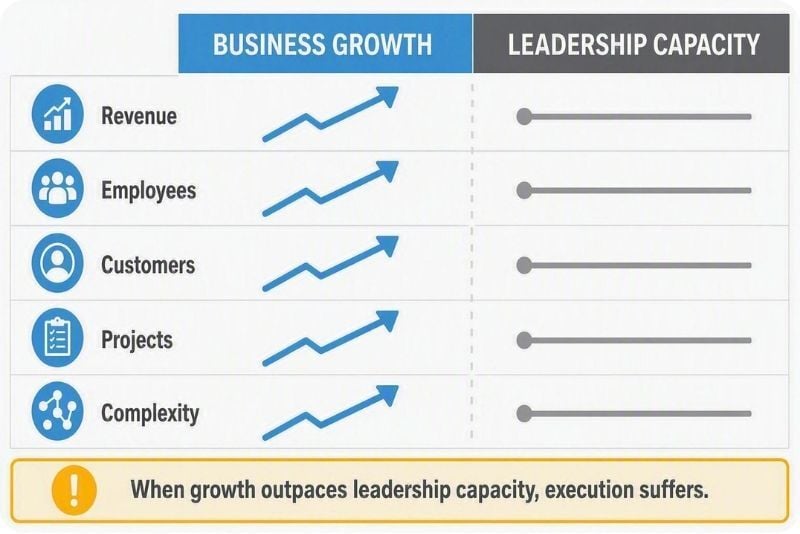
In reality, growth often exposes a different issue: leadership capacity.
As organizations expand, new customers, projects, technologies, and employees create increasing complexity. What worked when a company had 20 employees often breaks down at 100 employees. Decisions take longer. Strategic initiatives lose momentum. Teams become misaligned. The CEO becomes a bottleneck.
Most organizations do not suffer from a shortage of ideas.
They suffer from a shortage of leadership bandwidth.
The hidden cost of leadership gaps rarely appears on a financial statement, but it can significantly impact growth, profitability, and organizational performance.
What Is a Leadership Gap?
A leadership gap exists when critical business functions lack sufficient executive ownership, strategic guidance, or decision-making capacity.
In growing organizations, leadership gaps often appear when:
- The CEO is still making every major decision
- Strategic initiatives have no executive owner
- Managers are promoted without leadership development
- Technology projects lack executive oversight
- Operations teams are overwhelmed by growth
- Financial planning becomes reactive rather than strategic
- Succession planning does not exist
These gaps are not always obvious. Many businesses continue growing despite them.
The problem is that growth becomes harder, slower, and more expensive.
The Hidden Costs of Leadership Gaps
1. Delayed Strategic Initiatives
Many organizations launch ambitious projects such as:
- ERP implementations
- CRM modernization
- AI adoption initiatives
- Process improvement programs
- Cybersecurity enhancements
Yet months later, little progress has been made.
Why?
No executive has the time, expertise, or accountability to drive execution.
When important projects stall, businesses lose more than time. They lose competitive advantage, employee confidence, and market opportunities.
2. Leadership Bottlenecks
Founders and CEOs frequently become the default decision-makers for every major issue.
While this may work in the early stages of growth, it becomes a significant constraint as the organization scales.
Common warning signs include:
- Teams waiting for approval before acting
- Slower decision-making
- Missed opportunities
- Executive burnout
- Limited strategic thinking time
When every decision requires one person's involvement, growth becomes dependent on an individual's capacity rather than the organization's capability.
3. Reduced Accountability
Without clear executive ownership, initiatives often drift.
Projects remain active but produce little progress. Departments become siloed. Teams focus on urgent issues rather than strategic priorities.
The result is an organization that appears busy but struggles to execute.
Activity increases while outcomes decline.
4. Employee Frustration and Turnover
High-performing employees want direction, clarity, and support.
Leadership gaps often create:
- Confusing priorities
- Inconsistent communication
- Lack of career development
- Firefighting cultures
- Increased stress
Over time, strong performers become disengaged and seek opportunities elsewhere.
Replacing experienced employees is far more expensive than retaining them through effective leadership.
5. Increased Organizational Risk
Leadership gaps extend beyond growth initiatives.
They can also expose organizations to:
- Cybersecurity vulnerabilities
- Compliance issues
- Operational disruptions
- Financial governance challenges
- Customer experience problems
When no executive owns critical business functions, risks frequently go unnoticed until they become costly problems.
Why Growing SMBs Are Especially Vulnerable
Large enterprises typically have specialized executives dedicated to operations, technology, finance, and customer success.
Small and mid-sized businesses often do not.
Many growth-focused organizations have:
- A founder or CEO
- Department managers
- Strong contributors
But few strategic leaders focused on long-term execution.
As revenue grows and complexity increases, the leadership structure often fails to evolve at the same pace.
This creates a gap between business ambition and business capability.
Questions Every Executive Team Should Ask
If your organization is experiencing rapid growth, consider the following: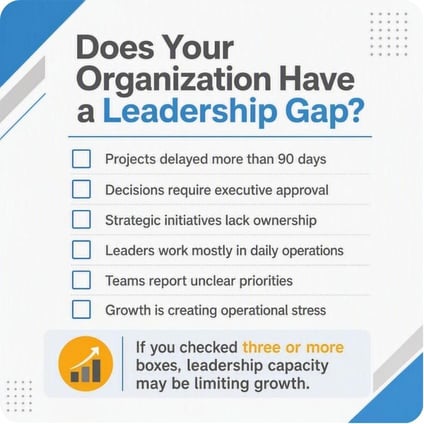
- Who owns our most important strategic initiatives?
- Where are decisions consistently delayed?
- Which projects have been sitting on the roadmap for more than six months?
- Are executives spending too much time in day-to-day operations?
- Where do we lack specialized leadership expertise?
- What initiatives would move faster with dedicated executive ownership?
The answers often reveal leadership constraints before they become major obstacles.
Closing Leadership Gaps Without Adding Full-Time
Executive Payroll
Addressing leadership gaps does not always require hiring a full executive team.
Many organizations successfully supplement their leadership structure through:
- Fractional executives
- Executive advisors
- Strategic consultants
- Interim leadership resources
- Leadership development programs
The goal is not simply adding people.
The goal is ensuring critical business functions have the leadership support necessary to execute successfully.
Final Thoughts
Every growing business invests in technology, talent, and operations.
Far fewer invest in leadership capacity.
Yet leadership is what connects strategy to execution.
When leadership gaps emerge, organizations often experience delayed projects, stalled growth, frustrated employees, and increased risk. The longer these gaps persist, the more expensive they become.
The most successful organizations are not always those with the best ideas.
They are the ones with the leadership capacity to turn ideas into results.
The Question Every Growing Business Should Ask
Your next growth challenge may not be finding more customers.
It may be ensuring you have the leadership capacity to support them.
If your organization is preparing for growth, digital transformation, AI adoption, operational expansion, or succession planning, now is the ideal time to evaluate whether your leadership structure can support your long-term goals.
Northern Lights partners with business leaders to bridge leadership gaps, improve execution, and build scalable organizations.
👉 Let's start a conversation about what's next for your business.